The Emirates Medical Residency Entrance Examination (EMREE) is the common entry exam for medical residency training in the United Arab Emirates. If you want to train in Abu Dhabi, Dubai or the Northern Emirates, you will almost certainly need it. This guide explains what the exam is, who runs it, who can sit it, what it tests, how much it costs, when it is held, how results work and how each health authority uses your score. Every fact is drawn from official sources, listed at the end, as checked on 1 November 2026.
EMREE UAE is an independent preparation platform and is not affiliated with UAE University, NIHS or any health authority.
What is EMREE?
EMREE is a qualifying examination for residency. The official exam structure page says: “This is only a qualifying exam and candidates must successfully pass this exam to qualify for residency training.” The requirements for acceptance into a programme are set separately by each participating authority. EMREE is not a licence to practise, and passing it does not guarantee a residency place.
The exam has two sister exams run by the same board: EDREE for dentistry and EPREE for pharmacy. This guide covers EMREE only. For a shorter introduction, see What is EMREE?.
Who runs it?
EMREE is conducted by the National Institute for Health Specialties (NIHS) at UAE University. The exam portal sits on the UAE University College of Medicine & Health Sciences (CMHS) domain and is branded NIHS. The board’s overview states that the regulatory authorities training resident physicians have a unified entry examination conducted by NIHS. The three authorities that use it are the Department of Health Abu Dhabi (DoH), Dubai Health (admissions through MBRU) and Emirates Health Services (EHS).
Who can sit EMREE?
The exam is open to all medical graduates and final-year medical students who satisfy the residency training application criteria of UAE health authorities. UAE nationals and all other nationalities who meet those criteria may register. Key points:
- No TOEFL or other English test is required to sit the exam. Residency programmes set their own English requirements.
- No licence is required to sit the exam.
- You may register for only one examination at a time.
- Non-residents must arrange their own UAE visa; neither UAEU nor the authorities are responsible for it.
- On the graduation-time limit, the FAQ defers to each institution. The authorities’ own limits differ.
Details are on our EMREE eligibility page, and the authorities’ residency criteria are compared in UAE residency eligibility.
Exam format
| Feature | Official position |
|---|---|
| Question type | Multiple choice questions (MCQs) |
| Number of questions | Usually 120 (the blueprint total is 120) |
| Time | 3 hours |
| Pilot items | Some unscored test questions may be added, with additional time |
| Delivery | Computer based; pencil and paper may be offered if circumstances require |
| Venue | College of Medicine & Health Sciences, Al Ain |
| Level | A graduate with at least one year of training, in a UAE context |
| Answer options and negative marking | Not stated on current official pages |
The legacy 2012 sample paper on the board’s site uses single-best-answer clinical vignettes with four options. Current pages do not confirm the number of options or whether negative marking applies, so treat any claim on those points with caution. More in EMREE exam pattern.
What EMREE tests: the blueprint
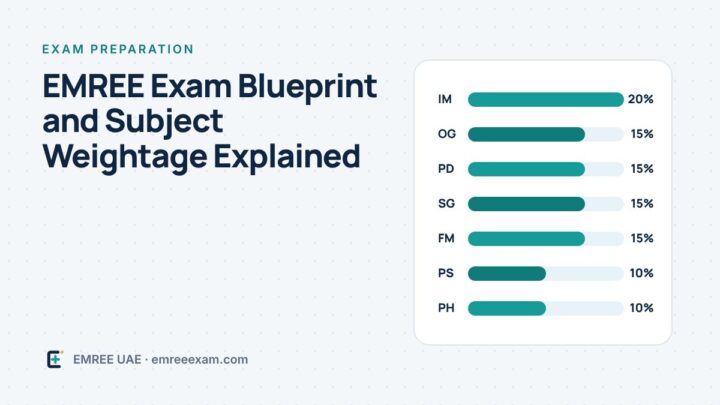
The official blueprint, dated Nov 2025, sets the weight of each discipline:
| Discipline | Weight | Approx. questions* |
|---|---|---|
| Internal Medicine | 20% | 24 |
| Obstetrics and Gynaecology | 15% | 18 |
| Paediatrics | 15% | 18 |
| Surgery | 15% | 18 |
| Family Medicine | 15% | 18 |
| Psychiatry | 10% | 12 |
| Public Health / Preventive Medicine | 10% | 12 |
*Our arithmetic (weight × 120). The blueprint publishes percentages only, and each category may vary by up to +/-5%.
It also sets a difficulty mix of 40% easy (48 questions), 40% moderately difficult (48) and 20% difficult (24), and approximate weights for physician tasks, from diagnoses and investigations (25–30%) to professionalism, ethics and communication (5–10%). In the content outline, Family Medicine consists of Ethics and Patient Safety topics. Our full breakdown is in EMREE Exam Blueprint and Subject Weightage.
Fees
The exam fee is AED 1,000. The home page says this excludes tax, while the application process page calls it an all-inclusive fee, so the VAT treatment is unclear; check at payment. The fee is paid online by credit card, and there are no refunds, no date changes and no fee transfers once you are enrolled. Residency applications are charged separately by some authorities: AED 600 at EHS, nothing at DoH, and an unstated amount at Dubai Health. See EMREE exam fees.
Dates: the 2025-26 cycle
The 2025-26 cycle had 12 EMREE sittings, from December 2025 to June 2026. Enrollment opens at 8:00 AM on the start day and closes at 11:59 PM on the end date, or earlier if seats fill, on a first-come, first-served basis.
| # | Enrollment window | Exam date | Result date |
|---|---|---|---|
| 1 | 10–17 Dec 2025* | Sun 21 Dec 2025 | 25 Dec 2025 |
| 2 | 10–31 Dec 2025* | Sun 4 Jan 2026 | 8 Jan 2026 |
| 3 | 10 Dec 2025*–14 Jan 2026 | Sun 18 Jan 2026 | 22 Jan 2026 |
| 4 | 2–31 Jan 2026 | Sun 1 Feb 2026 | 5 Feb 2026 |
| 5 | 2 Jan–11 Feb 2026 | Sun 15 Feb 2026 | 19 Feb 2026 |
| 6 | 2 Jan–25 Feb 2026 | Sun 1 Mar 2026 | 5 Mar 2026 |
| 7 | 2 Jan–4 Mar 2026 | Sun 8 Mar 2026 | 12 Mar 2026 |
| 8 | 17 Feb–10 Mar 2026 | Sat 14 Mar 2026 | 19 Mar 2026 |
| 9 | 23 Jan–11 Mar 2026 | Sun 15 Mar 2026 | 19 Mar 2026 |
| 10 | 23 Jan–18 Mar 2026 | Sun 22 Mar 2026 | 26 Mar 2026 |
| 11 | 18–24 Mar 2026 | Sat 28 Mar 2026 | 29 Mar 2026 |
| 12 | 12 May–9 Jun 2026 | Sun 14 Jun 2026 | 18 Jun 2026 |
*The site prints the first enrollment date as “Friday, December 10, 2025”; 10 December 2025 was a Wednesday. The NIHS calendar page gives a different enrollment end date for sitting 8.
The 2026-27 calendar had not been published as of 1 November 2026. The FAQ says the number of exams can change each year and dates are announced well in advance. Track updates on our EMREE exam dates page.
How to register
- Create an account on the exam board site with an email and a strong password. Accounts created before 1 December 2019 must re-register.
- Log in while an enrollment window is open and choose the exam from the Examinations menu.
- Pay online by credit card. Payment enrols you automatically and generates a receipt and reference number.
- Authorise your results to be sent to the organisation of your choice.
Step-by-step detail is in How to Register for the EMREE Exam.
Exam day
- Bring your passport and/or Emirates ID; face recognition is used.
- Arriving more than 10 minutes late means no entry.
- You cannot leave in the first 30 minutes.
- Lockers are provided, and a 15-minute practice session may be offered.
- There is one invigilator per 20 candidates.
Results, pass mark, validity and retakes
Results are issued as an electronic statement showing your score and ranking within ten working days; in 2025-26 they came out one to five days after each sitting. The pass mark for the 2025-26 cycle was 60%, set by standard setting and subject to change. Poorly performing questions are removed before final results are calculated.
- Validity: up to two years (24 months).
- Attempts: a maximum of three attempts to pass within one academic year. Candidates who passed in previous academic years get only one additional opportunity to retake.
- Transcript: every attempt, pass or fail, is shown and forwarded to the authorities. The FAQ warns that more retakes lower the chance of being considered.
- Appeals: an appeals page links to an NIHS form; no deadline or fee is stated.
See EMREE passing score and EMREE results.
How each authority uses your score
| Authority | What it asks for |
|---|---|
| DoH Abu Dhabi | UAE nationals: pass. UAE graduates and international graduates: 70 or more |
| Dubai Health / MBRU | EMREE or SMLE; score, percentile and attempts count in shortlisting (50% of the final rank) |
| EHS | A pass in EMREE |
These pathways are not identical. Read Medical Residency in UAE: Complete Guide and our UAE residency hub.
How to prepare
Start with the blueprint, take a timed baseline, and follow a plan weighted to the discipline percentages. Practise four-option single-best-answer vignettes at about 90 seconds per question, and take full-length mocks before your sitting. Our study guide, 90-day plan, EMREE MCQs and full-length mock exams are built for this. No resource can guarantee a pass, but a structured plan built on the official blueprint gives you the best use of your time.
Frequently asked questions
Is EMREE a licensing exam?
No. It is a qualifying exam for residency training. Licensing is handled separately, for example through DHA for Dubai Health residents.
How many questions are in EMREE?
Usually 120 multiple-choice questions in three hours, according to the official exam structure page. Some sittings add unscored pilot questions with extra time.
What is the EMREE pass mark?
60% for the 2025-26 cycle. The pass mark is set by standard setting and may change between cycles.
How much does EMREE cost?
AED 1,000. The official pages differ on whether VAT is included, and there are no refunds.
Where is EMREE held?
At the UAE University College of Medicine & Health Sciences in Al Ain. Official pages do not mention overseas centres.
Sources
Official information last verified on . Rules and dates can change — always confirm on the official site before you register or apply.
- EMREE exam board (NIHS, UAE University): home page
- EMREE exam board: overview
- EMREE exam board: exam structure
- EMREE exam board: FAQs
- EMREE exam board: application process
- EMREE exam board: processing of results
- EMREE exam board: examination rules
- EMREE Blueprint, Nov 2025 (PDF)
- NIHS: EMREE service and calendar
- Department of Health Abu Dhabi: Medical Residency Program (MEAD 2026)
- Dubai Health / MBRU: GME residency admissions
- Emirates Health Services: registration in the doctors' residency programmes