The EMREE blueprint is the single most important document for planning your preparation. Published by the National Institute for Health Specialties (NIHS) at UAE University and dated Nov 2025, it sets out how the 120 questions are distributed by discipline, by difficulty and by the type of clinical thinking they test, and it includes a detailed content outline and reading list. This article explains every table in it and how to use them. You can download the original from the official blueprint PDF.
Subject weightage (Table 1)
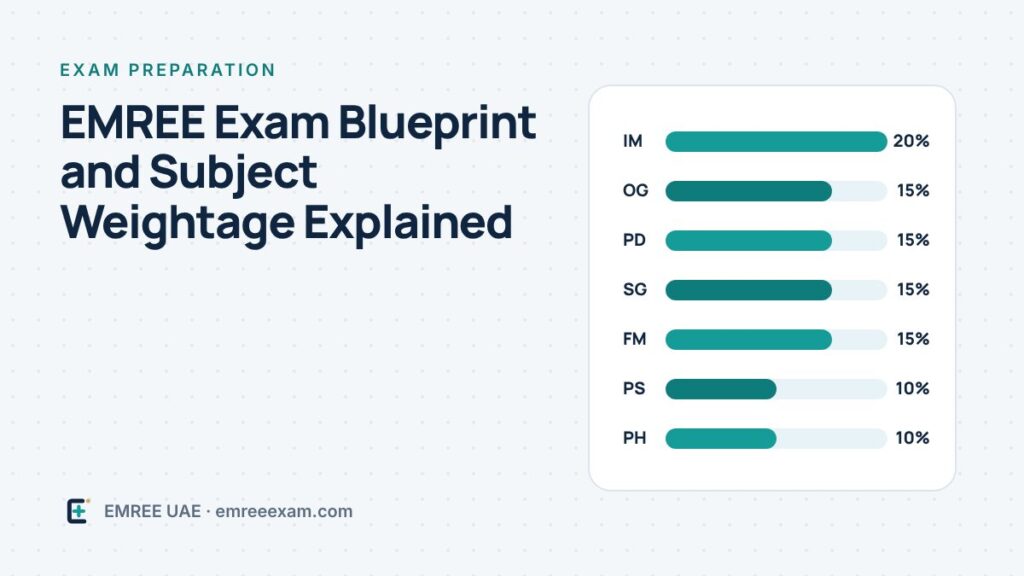
The blueprint assigns each of the seven disciplines a percentage of the exam:
| Discipline | Weight | Approx. questions* |
|---|---|---|
| Internal Medicine | 20% | 24 |
| Obstetrics and Gynaecology | 15% | 18 |
| Paediatrics | 15% | 18 |
| Surgery | 15% | 18 |
| Family Medicine | 15% | 18 |
| Psychiatry | 10% | 12 |
| Public Health / Preventive Medicine | 10% | 12 |
*Our arithmetic (weight × 120). The blueprint publishes percentages only, and each category may vary by up to +/-5%.
Three points matter for planning:
- Internal Medicine is the largest single discipline but only a fifth of the paper. The other 80% is spread across six disciplines.
- Family Medicine carries 15%, the same as Surgery or Paediatrics. In the content outline it consists of Ethics and Patient Safety topics, not general primary-care conditions.
- Psychiatry and Public Health / Preventive Medicine are 10% each. Together with Family Medicine, the three “smaller” disciplines make up 35%.
Tolerance
A note in the blueprint says distributions “may differ up to +/-5% in each category”. So a particular sitting might have somewhat more or fewer questions in a discipline than the headline figure.
What about the older FAQ wording?
The FAQ on the exam site still lists the disciplines as including “Community Medicine” and says all disciplines have fairly equal distribution except the last two. That text predates the Nov 2025 blueprint. The blueprint is the current, more detailed document, and we follow it.
Difficulty levels (Table 2)
| Suggested difficulty | % of questions | Number of questions |
|---|---|---|
| Easy | 40 | 48 |
| Moderately difficult | 40 | 48 |
| Difficult | 20 | 24 |
| Total | 120 |
Eighty per cent of questions are easy or moderately difficult. With a 2025-26 pass mark of 60%, a pass rests largely on getting the straightforward questions right consistently. That is an argument for broad, solid coverage over deep study of rare conditions.
Physician tasks and competencies (Table 3)
| Competency | Approximate weight |
|---|---|
| Fundamental Scientific Concepts | 10–20% |
| Clinical Features (history and physical examination) | 10–20% |
| Diagnoses & Investigations | 25–30% |
| Pharmacologic Therapies | 15–20% |
| Non-pharmacologic Management | 15–20% |
| Prevention & Health Maintenance | 5–10% |
| Professionalism, Ethics & Communication | 5–10% |
This table cuts across disciplines. Diagnoses and investigations is the largest category, and drug plus non-drug management together account for roughly 30–40%. For each condition you revise, make sure you know the key investigation and the first-line management, not only the presentation.
Cognitive domains (Table 4)
The blueprint lists two domains from Bloom’s taxonomy: Recall and Comprehension, and Analytical Reasoning and Evaluation. No weights are given. In practice, expect both straightforward knowledge questions and vignettes that require you to interpret findings and choose between plausible options.
Dimensions of care and physician activities
As a validity measure, items are also classified to sample different aspects of practice:
- Dimensions of care: Health Promotion, Illness Prevention and Communication; Acute; Chronic; and Psychosocial Aspects.
- Physician activities: Assessment/Diagnosis and Management.
These have no published weights, but they signal that the exam spans emergencies, long-term conditions, prevention and the social determinants of health.
The content outline
From page 9, the blueprint lists topics for each discipline. Some highlights:
Internal Medicine
Headings include cardiology, respiratory, gastroenterology, neurology, dermatology, musculoskeletal, infectious diseases, acute care, haematology/oncology, hepatology, nephrology, endocrine, rheumatology, oncology and geriatrics. Several paediatric conditions, such as croup, pyloric stenosis and Kawasaki disease, are printed under medicine headings.
Paediatrics
General paediatrics, ambulatory care (immunisation, development, growth, nutrition), neonatology, endocrinology, genetic and metabolic conditions, and allergy/immunology.
Obstetrics and Gynaecology
A long list spanning antenatal, intrapartum and postpartum care, early pregnancy, bleeding, gynaecology, reproductive endocrinology, oncology, and legal and ethical issues.
Surgery
Basic principles, general surgery, trauma and acute care, and subspecialties including urology, neurosurgery, orthopaedics, ENT and ophthalmology.
Family Medicine, Psychiatry and Public Health
Family Medicine covers ethics (consent, confidentiality, breaking bad news, DAMA, impaired physicians and more) and patient safety (international patient safety goals, medication safety, infection control, transfusion safety). Psychiatry lists 13 topics, from depression and self-harm to ADHD. Public Health covers screening, epidemiology, basic statistics, immunisation, outbreaks and lifestyle risk factors.
The outline states that the exam will emphasise certain parts of it, that no single exam covers every aspect, and that questions may include content not in the outline. Our clinical revision guides index every heading with links to practice questions.
The reading list
The blueprint ends with recommended texts for each discipline, including Davidson’s (24th edition), Harrison’s (21st), Kumar and Clark’s (11th) and Bailey & Love’s (28th), plus guideline bodies such as NICE, WHO, CDC, USPSTF, ACOG and RCOG. The committee notes the list is a study aid only, does not imply endorsement, and that questions are not necessarily taken from these sources. See recommended books.
How to use the blueprint in your preparation
- Allocate time by weight. In a 90-day plan, that means roughly two weeks for Internal Medicine and one to one and a half weeks for each other discipline. Our 90-day, 60-day and 30-day plans do this for you.
- Tick off the outline. Use our blueprint checklist on the free downloads page.
- Revise by competency. For each topic, cover presentation, investigation and first-line management.
- Practise by discipline, then mixed. Use our Internal Medicine, Family Medicine and other discipline MCQs, then full-length mocks.
- Check for updates. The blueprint says to see the website for the most up-to-date information.
Common misreadings of the blueprint
“Family Medicine means primary-care medicine”
In the Nov 2025 outline, Family Medicine is defined by Ethics and Patient Safety topics. Primary-care conditions such as hypertension, diabetes or asthma appear under Internal Medicine, Paediatrics or Public Health instead. Candidates who prepare Family Medicine as general practice risk missing a 15% block of ethics and safety questions.
“Psychiatry is only 13 topics, so it is quick”
The Psychiatry outline is short, but the blueprint warns that questions may include content outside it. Treat the 13 listed items as the core and revise common presentations around them, such as the assessment of suicide risk, the first-line treatment of depression and anxiety, and the recognition of psychiatric emergencies.
“The reading list is the syllabus”
The committee says the opposite: the list does not imply endorsement and questions are not necessarily taken from those books. The content outline, not the reading list, defines what is examined.
“Exact question counts are fixed”
Only percentages are published, with a tolerance of +/-5% in each category. Use the percentages to plan time, not to predict the exact number of questions in a sitting.
A worked example
Suppose you have 60 days and plan 50 content days. Applying the weights gives about 10 days for Internal Medicine, 7 to 8 days each for Obstetrics and Gynaecology, Paediatrics, Surgery and Family Medicine, and 5 days each for Psychiatry and Public Health. Within each block, spend more time on investigations and first-line management, in line with the competency table. Add a weekly mixed timed block and two full mocks, and you have a plan that mirrors the exam. This is our method, not an official one.
What we do not know
We could not retrieve the previous version of the blueprint, so we cannot say exactly what changed in Nov 2025. Official per-discipline question counts are not published; the counts in our table are arithmetic. For more context, read our Complete Guide to the EMREE Exam or the EMREE blueprint page.
Frequently asked questions
What is the subject weightage in EMREE?
Internal Medicine 20%; Obstetrics and Gynaecology, Paediatrics, Surgery and Family Medicine 15% each; Psychiatry and Public Health / Preventive Medicine 10% each, per the Nov 2025 blueprint.
How many questions are there per subject?
The blueprint publishes percentages only. Applied to 120 questions, they give about 24, 18, 18, 18, 18, 12 and 12, but each category can vary by up to 5%.
What does Family Medicine cover in EMREE?
In the official content outline, Family Medicine consists of Ethics and Patient Safety topics.
How difficult is EMREE?
The blueprint's suggested mix is 40% easy, 40% moderately difficult and 20% difficult questions, pitched at a graduate with at least one year of training.
Is the content outline complete?
No. The blueprint says no single exam covers all of it and questions may include content not in the outline.
Sources
Official information last verified on . Rules and dates can change — always confirm on the official site before you register or apply.